
Introduction
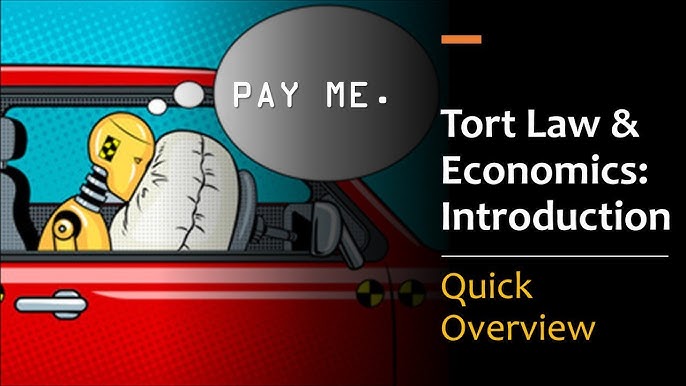
Tort law is one of the most significant areas in which law and economics intersect. Traditionally, tort law is concerned with providing remedies to individuals who suffer harm from the wrongful conduct of others. However, through the lens of economic analysis, tort law is viewed not just as a system for compensating victims, but as a mechanism for promoting efficient behavior and minimizing social costs associated with accidents and injuries.
The economic analysis of tort law focuses on incentives, deterrence, and efficiency. It examines how legal rules — such as negligence, strict liability, or contributory fault — affect the behavior of potential injurers and victims. Economists such as Guido Calabresi and Richard Posner were pioneers in applying microeconomic reasoning to legal doctrines, showing that tort rules can influence how people allocate resources toward accident prevention, safety investments, and risk-sharing.
Foundations of Economic Analysis in Tort Law
Economic analysis assumes that individuals act rationally to maximize their utility, responding to incentives created by the legal system. When someone faces potential liability for harm, they are motivated to take care to avoid causing injury if the expected cost of precaution is less than the expected cost of liability.
The economic purpose of tort law, therefore, is not merely to compensate victims, but to minimize the total costs of accidents — including both the cost of harm and the cost of preventing it. This idea is often referred to as social cost minimization.
In this framework, tort law serves two main functions:
- Deterrence: Encouraging individuals and firms to take efficient levels of care to avoid harming others.
- Compensation: Allocating losses to the party best able to bear or insure against them, promoting economic efficiency in risk distribution.
Models of Liability and Economic Efficiency
1. Negligence Rule
Under the negligence rule, a person is liable for damages only if they fail to take reasonable care — that is, if their conduct falls below a legal standard of due care. Economically, this system encourages individuals to take precisely the level of precaution that minimizes total social costs.
For example, suppose installing safety equipment costs $1,000 and reduces the expected harm of $5,000 by 50%. The efficient decision is to install the equipment if the expected benefit ($2,500 reduction in expected harm) exceeds the cost ($1,000). The negligence rule ensures that rational actors make such calculations, as failing to take reasonable precautions could result in liability for damages.
This rule is efficient because it aligns private incentives (avoiding liability) with social welfare (reducing harm efficiently). Once individuals take reasonable care, they are no longer liable, creating no incentive for excessive precaution.
2. Strict Liability
Strict liability holds a party responsible for damages regardless of fault or care. Economically, it is most efficient when the injurer can prevent accidents more easily than the victim can. For example, in cases involving hazardous activities (e.g., manufacturing explosives or keeping wild animals), strict liability ensures that those engaging in risky behavior internalize the potential harm.
However, strict liability may lead to over-deterrence, where injurers take excessively costly precautions or avoid beneficial activities altogether. Thus, strict liability is most efficient when paired with defenses such as contributory negligence, which balance the incentives between both parties.
3. Comparative Negligence
In systems with comparative negligence, both the injurer and victim may share responsibility for the accident. Damages are apportioned based on the degree of fault. Economically, this approach encourages both parties to take optimal care, since each bears part of the expected loss if they act negligently.
Economic Concepts in Tort Law
The Hand Formula
Judge Learned Hand introduced an economic test for negligence in United States v. Carroll Towing Co. (1947). According to the Hand Formula, an individual is negligent if:
B < P × L
where:
- B = the cost of taking precautions,
- P = the probability of harm, and
- L = the magnitude of the potential loss.
This formula provides a quantitative framework for assessing whether the level of care was economically justified. It implies that rational actors should take precautions if the cost of doing so is less than the expected harm. The rule ensures allocative efficiency by equating the marginal cost of prevention with the marginal reduction in expected harm.
Internalization of Externalities
Tort law also functions to internalize externalities — that is, to make injurers bear the full social cost of their actions. Without liability, individuals might impose risks or costs on others (such as pollution or unsafe products) without bearing the consequences. By imposing damages, tort law ensures that these external costs are reflected in the decision-making process, leading to more socially efficient outcomes.
Risk Distribution and Insurance
From an economic standpoint, tort law can also serve to spread risk efficiently. Compensation shifts losses from victims (who may be risk-averse and unable to bear large losses) to injurers or insurers (who are better positioned to distribute or pool risks). However, excessive insurance coverage can reduce incentives for care — a phenomenon known as moral hazard.
Applications and Policy Implications
1. Product Liability
Economic analysis has significantly influenced product liability law. By holding manufacturers liable for defective products, the law encourages investment in safety and quality control. However, excessive liability can increase prices or discourage innovation. Economists suggest designing liability rules that strike a balance between safety incentives and innovation incentives.
2. Medical Malpractice
In medical malpractice cases, the goal is to encourage physicians to take due care without practicing defensive medicine — performing unnecessary procedures to avoid liability. Economic studies have shown that well-calibrated liability systems can improve care quality, but overly punitive systems may raise healthcare costs without reducing errors.
3. Environmental Harm
Economic reasoning is also applied to environmental torts, such as pollution. When firms cause harm to public resources, liability rules can force them to internalize environmental costs. The Polluter Pays Principle reflects this economic logic, ensuring that firms incorporate environmental damages into their cost structures.
Critiques of Economic Analysis of Tort Law
While influential, the economic approach to tort law has been criticized for being too utilitarian and ignoring moral or distributive concerns. Critics argue that justice should not be reduced to cost-benefit calculations — that tort law must also uphold fairness, dignity, and accountability.
For example:
- Victims may deserve compensation regardless of efficiency considerations.
- Not all harms can be easily monetized (e.g., emotional distress, loss of life).
- Efficiency-focused rules might favor wealthier parties who can better absorb risks or afford precautions.
Moreover, real-world behavior often deviates from the rationality assumed in economic models. Behavioral law and economics has shown that cognitive biases, such as overconfidence or misjudgment of risks, can distort decision-making, complicating the goal of optimal deterrence.
Economic Efficiency vs. Justice.
A recurring debate in the field is whether economic efficiency should be the primary goal of tort law. Proponents argue that efficient outcomes maximize social welfare and prevent waste. Opponents contend that tort law should prioritize corrective justice — restoring victims to their rightful position — even if it is not economically optimal.
In practice, modern tort systems attempt to balance efficiency with fairness. For example, compensatory damages aim to make victims whole, while punitive damages deter particularly harmful conduct. Courts increasingly rely on economic reasoning for calculating damages, but moral considerations continue to guide judgments about liability and fairness.
Conclusion.
The economic analysis of tort law provides a powerful framework for understanding how legal rules shape behavior and allocate resources. By viewing tort law through an efficiency lens, policymakers can design liability systems that reduce accidents, promote precaution, and allocate losses effectively.
Yet, tort law also serves values beyond efficiency — justice, equity, and moral responsibility. The challenge lies in integrating economic reasoning with these broader social goals. A well-designed tort system recognizes that law and economics are complementary, not competing, forces: economics provides tools for achieving justice efficiently, while law ensures that efficiency serves the public good.